Pipeline Test Strategy
4 minute read
Everything that blocks deployment must be deterministic and under your control. Everything that involves external systems runs asynchronously or post-deployment. This gives you the independence to deploy any time, regardless of the state of the world around you.
Tests Inside the Pipeline
These tests run on every commit and block deployment if they fail. They must be fast, deterministic, and free of external dependencies.

Every test in this pipeline uses test doubles for external dependencies. No test calls a real external API, database, or third-party service. This means:
- A downstream outage cannot block your deployment. Your pipeline runs the same whether external systems are healthy or down.
- Tests are deterministic. The same code always produces the same result.
- The suite is fast. No network latency, no waiting for external systems to respond.
Why re-run tests post-merge?
Two changes can each pass pre-merge independently but conflict when combined on trunk. The post-merge run catches these integration effects. If a post-merge failure occurs, the team fixes it immediately. Trunk must always be releasable.
Tests Outside the Pipeline
These tests involve real external systems and are therefore non-deterministic. They never block deployment. Instead, they validate assumptions and monitor production health.
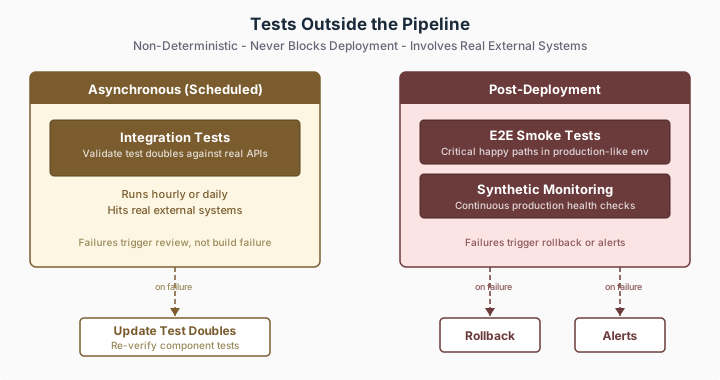
| Test Type | When It Runs | What It Does on Failure |
|---|---|---|
| Contract tests | On a schedule (hourly or daily) | Triggers review; team updates test doubles to match new reality |
| E2E smoke tests | After each deployment | Triggers rollback if critical path is broken |
| Synthetic monitoring | Continuously in production | Triggers alerts for operations |
How Contract Tests Validate Test Doubles
The pipeline’s deterministic tests depend on test doubles to represent external systems. But test doubles can drift from reality. An API adds a required field, changes a response format, or deprecates an endpoint. Contract tests close this gap.

- Pipeline tests use test doubles that encode your assumptions about external APIs - response schemas, status codes, error formats.
- Contract tests run on a schedule and send real requests to the actual external APIs.
- Contract tests compare the real response against what your test doubles return. They check structure and types, not specific data values.
- When a contract test passes, your test doubles are confirmed accurate. The pipeline’s deterministic tests are trustworthy.
- When a contract test fails, the team is alerted. They update the test doubles to match the new reality, then re-run component tests to verify nothing breaks.
This design means your pipeline never touches external systems, but you still catch when external systems change. You get both speed and accuracy.
Consumer-driven contracts
When the external API is owned by another team in your organization, you can go further with consumer-driven contracts. Instead of your team polling their API on a schedule, both teams share a contract specification (using a tool like Pact):
- You (the consumer) define the requests you send and the responses you expect.
- They (the provider) run your contract as part of their build. If a change would break your expectations, their build fails before they deploy.
- Your test doubles are generated from the contract, guaranteeing they match what the provider actually delivers.
This shifts contract validation from “detect and react” to “prevent.” See Contract Tests for implementation details.
Summary: All Stages at a Glance
| Stage | Blocks Deployment? | Uses Test Doubles? | Deterministic? |
|---|---|---|---|
| Every Commit | Yes | Yes - all external deps | Yes |
| Post-Merge | Yes | Yes - all external deps | Yes |
| Scheduled (Contract) | No - triggers review | No - hits real APIs | No |
| Post-Deploy (E2E) | No - triggers rollback | No - real system | No |
| Production (Monitoring) | No - triggers alerts | No - real system | No |
The Testing reference provides detailed documentation for each test type, including code examples and anti-patterns.
Related Content
- Testing Reference - Full reference for each test type
- Test Doubles - Patterns for stubs, mocks, fakes, spies, and dummies
- Contract Tests - Consumer-driven and provider contracts in detail
- Test Feedback Speed - The cognitive science behind the 10-minute target
- Pipeline Architecture - The pipeline structure these tests feed into
- Pipeline Reference Architecture - Reference diagrams for single-team and multi-team pipelines