These symptoms indicate problems with your testing strategy. Unreliable or slow tests erode
confidence and slow delivery. Each page describes what you are seeing and links to the
anti-patterns most likely causing it.
How to use this section
Start with the symptom that matches what your team experiences. Each symptom page explains what
you are seeing and identifies the most likely root causes (anti-patterns). Diagnostic questions
help you narrow down which cause applies to your situation. Follow the anti-pattern link to
find concrete fix steps.
1 - AI-Generated Code Ships Without Developer Understanding
Developers accept AI-generated code without verifying it against acceptance criteria, and functional bugs and security vulnerabilities reach production unchallenged.
What you are seeing
A developer asks an AI assistant to implement a feature. The generated code looks plausible.
The tests pass. The developer commits it.
Two weeks later, a security review finds the code accepts unsanitized input in a path nobody
specified as an acceptance criterion. Asked what the change was supposed to do, the developer
says, “It implements the feature.” Asked how they validated it, they say, “The tests passed.”
This is not an occasional gap. It is a pattern. Developers use AI to produce code faster.
But they do not define what “correct” means before generating code. They do not verify the
output against specific acceptance criteria, or consider how they would detect a failure in production.
The code compiles. The tests pass. Nobody validated the code against the actual requirements.
The symptoms compound over time. Defects appear in AI-generated code that the team cannot
diagnose quickly. Nobody defined what the code was supposed to do beyond “implement
the feature.” Developers fix defects by asking the AI to fix its own output, without
re-examining the original acceptance criteria. Security vulnerabilities - injection flaws, broken access
controls, exposed credentials - ship because nobody asked “what are the security constraints
for this change?” before or after generation.
Common causes
Rubber-stamping AI-generated code
Some teams do not expect developers to own what a change does and how they validated it,
regardless of who or what wrote the code. On those teams, AI output gets the same cursory
glance as a trivial formatting change. The team treats “AI wrote it and the tests pass” as
sufficient evidence of correctness. That evidence is not sufficient. Passing tests prove the code satisfies the test cases. They do not
prove the code meets the actual requirements or handles the constraints the team cares about.
A work item can lack concrete acceptance criteria: specific inputs, expected outputs,
security constraints, and edge cases. Then neither the developer nor the AI has a clear target. The AI
generates something that looks right. The developer has no checklist to verify it against. The
review is a subjective “does this seem okay?” rather than an objective “does this satisfy every
stated requirement?”
Some test suites rely heavily on end-to-end tests and lack targeted unit and component tests.
AI-generated code can pass such a suite without anyone verifying its internal logic. A
comprehensive component test suite would catch the cases where the AI’s implementation
diverges from the domain rules. Without component tests, “tests pass” is a weak signal.
Can developers explain what their recent changes do and how they validated them? Pick
three recent AI-assisted commits at random. Ask the committing developer three questions.
What does this change accomplish? What acceptance criteria did you verify? How would you
detect if the change were wrong? If they cannot answer, the review process is not catching unexamined code.
Start with
Rubber-Stamping AI-Generated Code.
Do your work items include specific, testable acceptance criteria before implementation
starts? If acceptance criteria are vague or added after the fact, neither the AI nor the
developer has a clear target. Start with
Monolithic Work Items.
Does your test suite include component tests that verify business rules with specific
inputs and outputs? If the suite is mostly end-to-end or integration tests, AI-generated
code can pass those tests and still break business rules. Start with
Inverted Test Pyramid.
2 - Tests Pass in One Environment but Fail in Another
Tests pass locally but fail in CI, or pass in CI but fail in staging. Environment differences cause unpredictable failures.
What you are seeing
A developer runs the tests locally and they pass. They push to CI and the same tests fail. Or the
CI pipeline is green but the tests fail in the staging environment. A code defect does not cause
these failures. Differences between environments cause them: a different OS version, database
version, or timezone setting. A missing environment variable or a service that is available
locally but not in CI has the same effect.
The developer spends time debugging the failure and discovers the root cause is environmental, not
logical. They add a workaround (skip the test in CI, add an environment check, adjust a timeout)
and move on. These workarounds accumulate over time. The test suite becomes littered with
environment-specific conditionals and skipped tests.
The team loses confidence in the test suite because results depend on where the tests run rather
than whether the code is correct.
Common causes
Snowflake environments
When people configure each environment by hand and maintain it independently, the environments
drift apart over time. The developer’s laptop has one version of a database driver. The CI server
has another. The staging environment has a third. These differences stay invisible until a test
exercises a code path that behaves differently across versions.
Do not harmonize configurations manually, because they will drift again. Provision all
environments from the same infrastructure code.
When deployment and environment setup are manual processes, subtle differences creep in. One
developer installed a dependency a particular way. A different person configured the CI server
with slightly different settings. Someone set up the staging environment months ago and nobody
has updated it. Manual processes are never identical twice, and the variance causes environment-
dependent behavior.
Some applications have hidden dependencies on external state, such as filesystem paths, network
services, or system configuration. Tests for these applications work in one environment and fail
in another because the external state differs. Well-isolated code with explicit dependencies is portable across
environments. Tightly coupled code that reaches into its environment for implicit dependencies is
fragile.
Are all environments provisioned from the same infrastructure code? If not, environment
drift is the most likely cause. Start with
Snowflake Environments.
Are environment setup and configuration manual? If different people configured different
environments, the variance is a direct result of manual processes. Start with
Manual Deployments.
Do the failing tests depend on external services, filesystem paths, or system
configuration? If tests assume specific external state rather than declaring explicit
dependencies, the code’s coupling to its environment is the issue. Start with
Tightly Coupled Monolith.
Test coverage numbers look healthy but defects still reach production.
What you are seeing
Your dashboard shows 80% or 90% code coverage, but bugs keep getting through. Defects show up
in production that feel like they should have been caught. The team points to the coverage
number as proof that testing is solid, yet the results tell a different story.
People start losing trust in the test suite. Some developers stop running tests locally because
they do not believe the tests will catch anything useful. Others add more tests, pushing
coverage higher, without the defect rate improving.
Common causes
Inverted test pyramid
When most of your tests are end-to-end or integration tests, they exercise many code paths in a
single run - which inflates coverage numbers. But these tests often verify that a workflow
completes without errors, not that each piece of logic produces the correct result. A test that
clicks through a form and checks for a success message covers dozens of functions without
validating any of them in detail.
When teams face pressure to hit a coverage target, testing becomes theater. Developers write
tests with trivial assertions to get the number up. These tests check only that a function
returns without throwing, or that a value is not null. The coverage metric looks healthy, but the tests
do not actually verify behavior. They exist to satisfy a gate, not to catch defects.
When the organization gates the pipeline on a coverage target, teams optimize for the number
rather than for defect detection. Developers write assertion-free tests, cover trivial code, or
add single integration tests that execute hundreds of lines without validating any of them. The
coverage metric rises while the tests remain unable to catch meaningful defects.
When test automation is absent or minimal, teams sometimes generate superficial tests. Others rely
on coverage from integration-level runs that touch many lines without asserting meaningful outcomes.
The coverage tool counts every line that executes, regardless of whether any test validates the
result.
Do most tests assert on behavior and expected outcomes, or do they only verify that code
runs without errors? If tests mostly check for no-exceptions or non-null returns, the
problem is testing theater - tests written to hit a number, not to catch defects. Start with
Pressure to Skip Testing.
Are the majority of your tests end-to-end or integration tests? If most of the suite runs
through a browser, API, or multi-service flow rather than testing units of logic directly,
start with Inverted Test Pyramid.
Does the pipeline gate on a specific coverage percentage? If the team writes tests
primarily to keep coverage above a mandated threshold, start with
Code Coverage Mandates.
Were tests added retroactively to meet a coverage target? If the team wrote most tests
after the code to satisfy a coverage gate rather than to verify design decisions, start with
Pressure to Skip Testing.
ACD - How ineffective tests undermine the acceptance criteria that agents depend on
4 - A Large Codebase Has No Automated Tests
Zero test coverage in a production system being actively modified. Nobody is confident enough to change the code safely.
What you are seeing
Every modification to this codebase is a gamble. The system has no automated tests. Changes are validated through manual testing, if they are validated at all. Developers work carefully. They know that any change could trigger failures in code they did not touch, because the system has no seams and no isolation. The only way to know if a change works is to deploy it and observe what breaks.
Refactoring is effectively off the table. Improving the design of the code requires changes that should not alter behavior. With no tests, nobody can verify that the behavior stayed the same. Developers choose to add code around existing code rather than improve it, because change is unsafe. The codebase grows more complex with every feature because improving the underlying structure carries too much risk.
The team knows the situation is unsustainable but cannot see a path out. “We should write tests” appears in every retrospective. The problem is that adding tests to an untestable codebase requires refactoring first - and refactoring requires tests to do safely. The team is stuck in a loop with no obvious entry point.
Common causes
Manual testing only
The team has relied on manual testing as the primary quality gate. Automated tests were never required, never prioritized, and never resourced. The codebase was built without testability as a design constraint. As a result, the architecture does not accommodate automated testing without structural change.
Making the transition requires a deliberate commitment. New code always gets tests, existing code gets tests when someone modifies it, and high-risk areas get retrofitted coverage first. Over months, the unsafe areas of the codebase shrink. A test suite that catches failures before production replaces the cycle of deploying to discover breakage.
Code without dependency injection, without interfaces, and without clear module boundaries cannot be tested without a major structural overhaul. Every function calls other functions directly. Every component reaches into every other component. Writing a test for one function requires instantiating the entire system.
Introducing seams - interfaces, dependency injection, module boundaries - makes code testable. This work is not glamorous, and its value stays invisible until the team starts writing tests. But seams are the prerequisite for meaningful test coverage in a tightly coupled system. Once the seams exist, you can test functions in isolation instead of instantiating the full application. Developers stop needing to deploy to find out if a change is safe.
If management has historically prioritized features over tests, the codebase will reflect that history. Tests were deferred sprint by sprint. Technical debt accumulated. Today’s team inherits the decisions of teams that operated under different constraints. The codebase carries the record of every time testing lost to deadline pressure.
Reversing this history requires organizational commitment to treat test coverage as a delivery requirement, not as optional work that gets squeezed out when time is short. Without that commitment, the same pressure that created the untested codebase will prevent escaping it - and developers will keep gambling on every deploy.
Can any single function in the codebase be tested without instantiating the entire application? If not, the architecture lacks the seams that unit tests need. Start with Tightly coupled monolith.
Has the team ever had a sustained period of writing tests as part of normal development? If not, the practice was never established. Start with Manual testing only.
Did historical management decisions consistently deprioritize testing? If test debt accumulated from external pressure, the organizational habit must change first. Only then can the technical situation improve. Start with Pressure to skip testing.
Internal code changes that do not alter behavior cause widespread test failures.
What you are seeing
A developer renames a method, extracts a class, or reorganizes modules - changes that should not
affect external behavior. But dozens of tests fail. The failures are not catching real bugs.
They are breaking because the tests depend on implementation details that changed.
Developers start avoiding refactoring because the cost of updating tests is too high. Code
quality degrades over time because cleanup work is too expensive. When someone does refactor,
they spend more time fixing tests than improving the code.
Common causes
Inverted test pyramid
When end-to-end and integration tests dominate the test suite, those tests tend to couple
tightly to implementation details. Examples include CSS selectors, API response shapes, DOM
structure, or specific sequences of internal calls. A refactoring that changes no observable
behavior still breaks these tests. They assert on how the system works rather than what it does.
Unit tests focused on behavior (“given this input, expect this output”) survive refactoring.
Tests coupled to implementation (“this method was called with these arguments”) do not.
When components lack clear interfaces, tests reach into the internals of other modules. A
refactoring in module A breaks tests for module B - not because B’s behavior changed, but
because B’s tests were calling A’s internal methods directly. Without well-defined boundaries,
every internal change ripples across the test suite.
Do the broken tests assert on internal method calls, mock interactions, or DOM structure?
If yes, the tests are coupled to implementation rather than behavior. The problem is test
design. Start with Inverted Test Pyramid for guidance
on building a behavior-focused test suite.
Are the broken tests end-to-end or UI tests that fail because of layout or selector
changes? If yes, too many tests sit at the wrong level of the pyramid. Start with
Inverted Test Pyramid.
Do the broken tests span multiple modules - testing code in one area but breaking because
of changes in another? If yes, the problem is missing boundaries between components. Start
with Tightly Coupled Monolith.
Unit Tests - Black box testing that survives internal changes
Test Doubles - Using test doubles without coupling to implementation
6 - Test Environments Take Too Long to Reset Between Runs
The team cannot run the full regression suite on every change because resetting the test environment and database takes too long.
What you are seeing
The team has a regression test suite that covers critical business flows. Running the tests
themselves takes twenty minutes. Resetting the test environment - restoring the database to a
known state, restarting services, clearing caches, reloading reference data - takes another
forty minutes. The total cycle is an hour. With multiple teams queuing for the same environment,
a developer might wait half a day to get feedback on a single change.
The team makes a practical decision: run the full regression suite nightly, or before a release,
but not on every change. Individual changes get a subset of tests against a partially reset
environment. Bugs that depend on data state - stale records, unexpected reference data, leftover
test artifacts - slip through because the partial reset does not catch them. The full suite
catches these bugs later. By then, the team has merged several changes, and finding the one
that introduced the regression takes a multi-person investigation.
Some teams stop running the full suite entirely. The reset time is so long that the suite
becomes a release gate rather than a development tool. Developers lose confidence in the
suite because they rarely see it run. The failures they do see are often environment
artifacts rather than real bugs.
Common causes
Shared test environments
When multiple teams share a single test environment, the environment is never in a clean state.
One team’s tests leave data behind. Another team’s tests depend on data that was deleted moments earlier.
Resetting the environment means restoring it to a state that works for all teams, which
requires coordination and takes longer than resetting a single-team environment.
The shared environment also creates queuing. Only one test run can use the environment at a
time. Each team waits for the previous run to finish and the environment to reset before
starting their own.
When the regression suite is treated as a manual checkpoint rather than an automated pipeline
stage, the environment setup is also manual or semi-automated. Scripts that restore the
database, restart services, and verify the environment is ready have accumulated over time
without being optimized. Nobody has invested in making the reset fast because the suite was
never intended to run on every change.
Some tests require live databases, running services, and real network connections for every
assertion. The environment reset is then slow because every dependency must return to a known
state. A test that validates billing logic should not need a running payment gateway. A test
that checks order validation should not need a populated product catalog database.
The fix is to match each test to the right layer. Component tests that verify business rules
use in-memory databases or controlled fixtures - no environment reset needed. Contract tests
verify service boundaries with virtual services instead of live instances. Only a small number
of end-to-end tests need the fully assembled environment, and those run outside the pipeline’s
critical path. If the pipeline’s critical path depends on heavyweight integration for every
assertion, the long reset time comes directly from testing at the wrong layer.
When testing is deferred to a late stage - after development, after integration, before release
the tests assume a fully assembled system with a production-like database. Resetting that
system is inherently slow because it involves restoring a large database, restarting multiple
services, and verifying cross-service connectivity. The tests were designed for a heavyweight
environment because they run at a heavyweight stage.
Tests designed to run early - component tests with controlled data, contract tests between
services - do not need environment resets. They run in isolation with their own data fixtures.
Is the environment shared across multiple teams or test suites? If teams queue for a
single environment, the reset time is compounded by coordination. Start with
Shared Test Environments.
Does the reset process involve restoring a large database from backup? If the database
restore is the bottleneck, the tests depend on global data state. They do not control
their own data. Start with
Manual Regression Testing Gates
and refactor tests to use isolated data fixtures.
Do most tests require live databases, running services, or network connections? If the
majority of tests need the fully assembled environment, the suite tests at the wrong
layer. Component tests with in-memory databases and virtual services for
external dependencies would eliminate the reset bottleneck for most assertions. Start with
Inverted Test Pyramid.
Does the full suite only run before releases, not on every change? If the suite is a
release gate rather than a pipeline stage, it was designed for a different feedback loop.
Start with
Testing Only at the End and move
tests earlier in the pipeline.
Testing Fundamentals - Building a test strategy that does not depend on slow environment resets
7 - Test Suite Is Too Slow to Run
The test suite takes 30 minutes or more. Developers stop running it locally and push without verifying.
What you are seeing
The full test suite takes 30 minutes, an hour, or longer. Developers do not run it locally because
they cannot afford to wait. Instead, they push their changes and let CI run the tests. Feedback
arrives long after the developer has moved on. If a test fails, the developer must context-switch
back, recall what they were doing, and debug the failure.
Some developers run only a subset of tests locally (the ones for their module) and skip the rest.
This catches some issues but misses integration problems between modules. Others skip local testing
entirely and treat the CI pipeline as their test runner, which overloads the shared pipeline and
increases wait times for everyone.
The team has discussed parallelizing the tests, splitting the suite, or adding more CI capacity.
These discussions stall because the root cause is not infrastructure. It is the shape of the test
suite itself.
Common causes
Inverted test pyramid
When the majority of tests are end-to-end or integration tests, the suite is inherently slow. E2E
tests launch browsers, start services, make network calls, and wait for responses. Each test takes
seconds or minutes instead of milliseconds. A suite of 500 E2E tests is always slower than
5,000 unit tests that verify the same logic at a lower level. Faster hardware does not fix the
problem. Moving test coverage down the pyramid does.
When the codebase has no clear module boundaries, tests cannot be scoped to individual components.
A test for one feature must set up the entire application because the feature depends on
everything. Test setup and teardown dominate execution time because there is no way to isolate the
system under test.
Sometimes the test suite is slow because the team added automated tests as an afterthought. The
team used E2E tests to backfill coverage for code that was not designed for unit testing. The
resulting suite is a collection of heavyweight tests that exercise the full stack for every
scenario, because the code provides no lower-level testing seams.
What is the ratio of unit tests to E2E/integration tests? If E2E tests outnumber unit
tests, the test pyramid is inverted and the suite is slow by design. Start with
Inverted Test Pyramid.
Can tests be run for a single module in isolation? If running one module’s tests requires
starting the entire application, the architecture prevents test isolation. Start with
Tightly Coupled Monolith.
Were the automated tests added retroactively to a codebase with no testing seams? If the
team bolted on E2E tests after the fact because the code cannot be unit-tested, the codebase
needs refactoring for testability. Start with
Manual Testing Only.
Build Duration - Track pipeline speed as a first-class metric
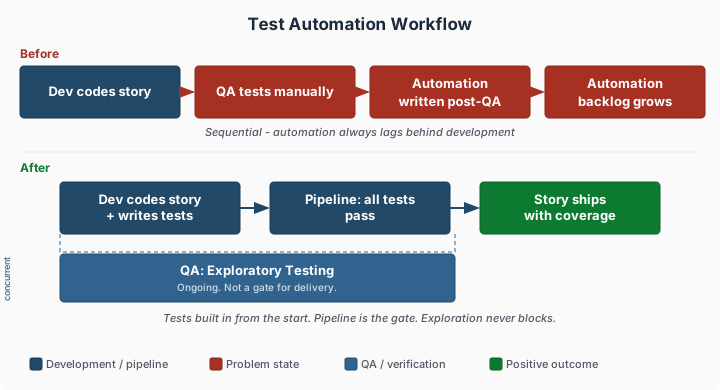
8 - Test Automation Always Lags Behind Development
Manual QA runs first, then automation is written from those results. Automation never catches up because it is always one step behind.
What you are seeing
Development completes a user story. It moves to QA. A QA engineer manually tests it, finds issues, they get fixed, and QA re-tests. Once manual testing passes, someone writes automated tests based on what QA verified. By then, development is three stories further along. The automation backlog never shrinks because the process guarantees it will always be one sprint behind.
Teams in this situation often wonder whether AI can close the gap by generating tests from requirements. AI tools can scaffold test cases from acceptance criteria, and that can reduce the time it takes to write automation. But if the process still sequences automation after manual QA sign-off, the lag persists. The bottleneck is structural. Automation that arrives after manual testing adds cost without adding speed.
A subtler problem is that automation written from manual QA results tends to encode what testers happened to check rather than what the requirements demand. Edge cases not discovered during manual testing remain uncovered in automation. The test suite grows to confirm what the team already knows, not to catch what it does not know yet.
Workflow comparison
Common causes
Testing only at the end
When testing is a phase that begins after development is marked complete, automation inherits that sequencing. Developers hand work to QA. QA validates it manually. Automation follows. There is no structural point in the workflow where automated tests are expected before the story ships. The lag is not a failure of discipline. It is the natural output of a process that positions testing downstream of development.
Shifting automation earlier requires treating automated tests as a delivery requirement, not a follow-up activity. Stories are not complete until automated tests exist and pass. Developers write or contribute to those tests as part of finishing the work. Manual QA shifts from primary verification to exploratory testing, catching edge cases the automated suite does not cover.
When a separate QA team owns both manual testing and test automation, developers have no role in either. Developers write code; QA writes tests. The division feels natural (testing is QA’s job), but the division means the team most familiar with implementation details is not writing the tests. QA automation engineers are translating manual test results into code rather than working from source knowledge of the system.
When developers share responsibility for automated tests, automation can be written as code is written. A QA engineer reviewing a story during development can identify what needs automated coverage. A developer finishing a feature can write the corresponding unit and integration tests. The handoff that creates the lag disappears because there is no handoff.
When manual testing is the established quality gate, automated testing is treated as an enhancement rather than a requirement. Automation is written when time permits, which means it is written after the work that is required. The team talks about eliminating manual testing, but the delivery process does not enforce automated test coverage. Manual testing remains the gate, and automation remains optional.
Making automated test coverage a hard requirement (nothing ships without it) reorders the priorities. The question changes from “will we have time to automate this?” to “what automated tests does this story require?” Manual testing does not disappear. It becomes the secondary layer rather than the primary one.
Is there a step in your workflow where a story moves from “dev complete” to “QA”? If work moves to a separate QA queue before anyone writes automated tests, the process puts automation after manual testing by design. Start with Testing Only at the End.
Do developers write automated tests for their own stories, or does a separate team write them? If automation is QA’s responsibility, the structure excludes developers from the work that could close the lag. Start with Siloed QA Team.
Can a story ship without automated test coverage? If manual QA sign-off is enough to release, the team defers automation whenever time is short. Time is often short. Start with Manual Testing Only.
9 - Tests Interfere with Each Other Through Shared Data
Tests share mutable state in a common database. Results vary by run order, making failures unreliable signals of real bugs.
What you are seeing
Your test suite is technically running, but the results are a coin flip. A test that passed yesterday fails today because another test ran first and left dirty data in the shared database. You spend thirty minutes debugging a failure only to find the root cause was a record inserted by an unrelated test two hours ago. When you rerun the suite in isolation, everything passes. When you run it in CI with the full suite, it fails at random.
Shared database state is the source of the chaos. The database schema and seed data were set up once, years ago, by someone who has since left. Nobody is sure what state the database is supposed to be in before any given test. Some tests clean up after themselves; most do not. Some tests depend on records created by other tests. The execution order matters, but nobody explicitly controls it - so the suite is fragile by construction.
The downstream effect is that your team has stopped trusting test failures. When a red build appears, the first instinct is not “there is a bug” but “someone broke the test data again.” You rerun the build. It goes green, and you ship. Real bugs make it to production because the signal-to-noise ratio of your test suite has collapsed.
Common causes
Manual testing only
Teams that have relied on manual testing tend to reach for a shared database. Testers have always worked against a shared test environment, so a shared database feels natural. When the team adds automated tests later, those tests inherit the same model: one environment, one database, shared by everyone. Nobody designed a data strategy; it evolved from how the team already worked.
When teams shift to isolated test data - each test owns and tears down its own data - interference disappears. Tests become deterministic. A failing test means code is broken, not the environment.
When most automated tests are end-to-end or integration tests that exercise a real database, test data problems compound. Each test requires realistic, complex data to be in place. The more tests that depend on a shared database, the more opportunities for interference and the harder it becomes to manage the data lifecycle.
Shifting toward a pyramid with a large base of unit tests reduces database dependency dramatically. Unit tests run against in-memory structures and do not touch shared state. The integration and end-to-end tests that remain can be designed more carefully with isolated, purpose-built datasets. With fewer tests competing for shared database rows, the random CI failures that triggered “just rerun it” reflexes become rare. A red build becomes a signal worth investigating.
When test environments are hand-crafted and not reproducible from code, database state drifts over time. Schema migrations get applied inconsistently. Seed data scripts run at different times in different environments. Each environment develops its own data personality, and tests written against one environment fail on another.
Reproducible environments - created from code on demand and destroyed after use - eliminate drift. When the pipeline provisions the database fresh from a migration script and a known seed set for each test run, the starting state is always predictable. Tests that produced different results on different machines or at different times become consistent. The team can stop dismissing CI failures as environment noise.
Do tests pass when run individually but fail when run together? Mutual interference from shared mutable state is the most likely cause. Start with Inverted test pyramid.
Does the test suite pass on one machine but fail in CI? The test environment differs from the developer’s local database. Start with Snowflake environments.
Is there no documented strategy for setting up and tearing down test data? The team never established a data strategy. Start with Manual testing only.
The pipeline fails, the developer reruns it without changing anything, and it passes.
What you are seeing
A developer pushes a change. The pipeline fails on a test they did not touch, in a module they
did not change. They click rerun. The pipeline passes. They merge.
This cycle repeats multiple times a day across the team. Nobody investigates failures on the first occurrence because the odds favor flakiness
over a real problem.
The team has adapted: retry-until-green is a routine step, not an exception. Some pipelines
automatically rerun failed tests. The team tags tests as “known flaky” and skips them.
Real regressions hide behind the noise because the team has been trained to ignore failures.
Common causes
Inverted test pyramid
When end-to-end tests dominate the test suite, flakiness is structural. E2E tests depend
on network connectivity, shared test environments, external service availability, and browser
rendering timing. Any of these can produce a different result on each run. A suite built mostly
on E2E tests will always be flaky because it is built on non-deterministic foundations.
Replacing E2E tests with component tests that use test doubles for external dependencies makes
the suite deterministic by design. The test produces the same result every time because it
controls all its inputs.
The CI environment might differ from other environments or drift over time. Then
tests pass locally but fail in CI, or pass in CI on Tuesday but fail on Wednesday. The
inconsistency is not in the test or the code but in the environment the test runs in.
Tests that depend on specific environment configurations, installed packages, file system layout,
or network access are vulnerable to environment drift. Infrastructure-as-code eliminates this
class of flakiness by ensuring environments are identical and reproducible.
Components can share mutable state, such as a database, a cache, or a filesystem directory.
Then tests that run concurrently or in a specific order can interfere with each other. Test A writes to a shared
table. Test B reads from the same table and gets unexpected data. The tests pass individually
but fail together, or pass in one order but fail in another.
Without clear component boundaries, you cannot isolate tests. The flakiness is a symptom of
architectural coupling, not a testing problem.
Do the flaky tests hit real external services or shared environments? If yes, the tests
are non-deterministic by design. Start with
Inverted Test Pyramid and replace them with
component tests using test doubles.
Do tests pass locally but fail in CI, or vice versa? If yes, the environments differ.
Start with Snowflake Environments.
Do tests pass individually but fail when run together, or fail in a different order? If
yes, tests share mutable state. Start with
Tightly Coupled Monolith for the
architectural root cause, and isolate test data as an immediate fix.